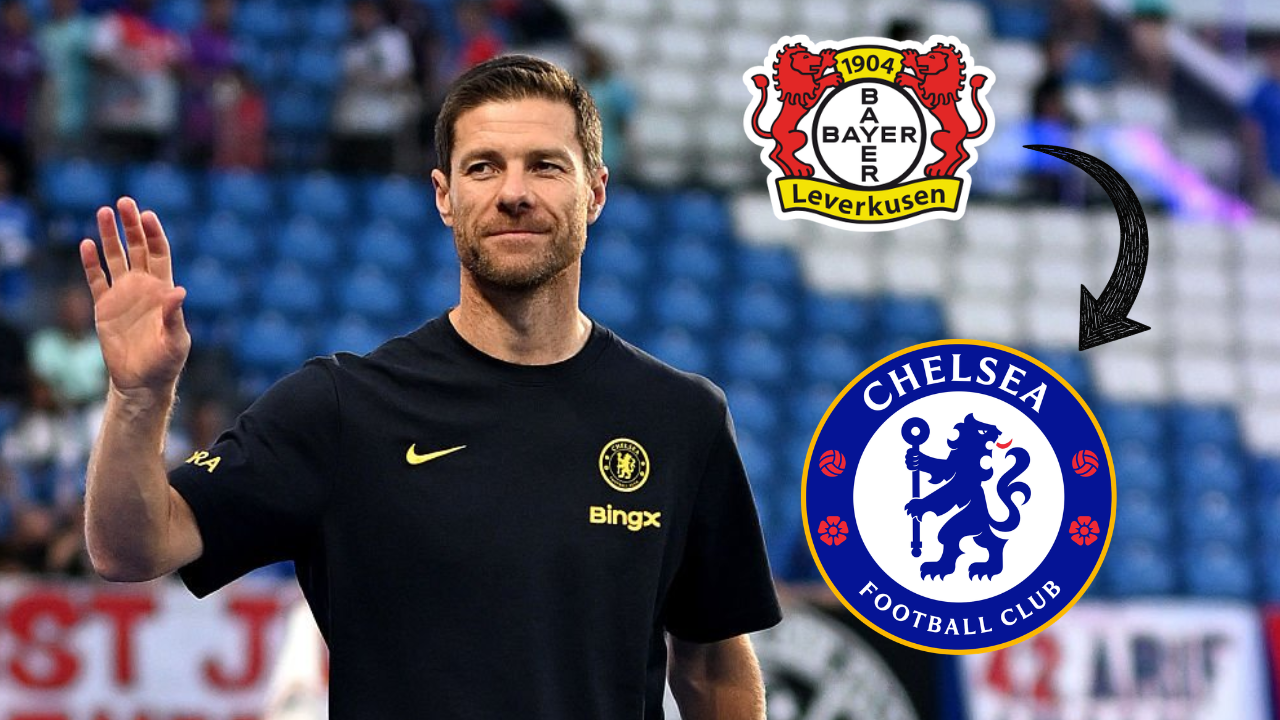
Chelsea’s Premier League season kicks off in just over a week, and it is still somewhat unknown what system Xabi Alonso will play.
Alonso made his managerial name with Bayer Leverkusen, leading them to historic success under his now ‘signature’ 3-4-2-1 formation. He then made the big move to Real Madrid, where he played a back 4 in his short tenure there. So the question remains: will Alonso bring back his ever-successful 3-4-2-1 formation to the Premier League?
Many of Chelsea’s offseason signings point towards a wingback system. For their preseason tour, they lined up in a 4-2-3-1 for their first three games, and a 3-4-2-1 in their last three.
All reports are that Alonso is going to mix it up and play both formations, and I am sure we will see a mix of a back 3 and back 4 played throughout the season. In saying that, every successful team needs a strong identity, and that will require Alonso to pick a system to focus on.
I think Alonso will play his 3-4-2-1 this season, and it comes down to one thing. Chelsea’s personnel is perfect for this system.
How so? Well, we know how well it worked at Leverkusen, so what better way to prove Chelsea’s compatibility with this system than to compare personnel between the two squads.
*All references to player grades and rankings are sourced from https://fc.gradientsports.com/, and all graphs are from https://datamb.football/
Goalkeeper
At Leverkusen, Hrádecký served as the number one goalkeeper. As it stands, Robert Sánchez is expected to keep his starting job between the sticks, while Mike Penders serves as his backup.

Obviously, the role of goalkeepers in football remains mostly unchanged from system to system. However, the one thing that might change is their role as a distributor in the team.
Alonso’s system at Leverkusen was very possession-heavy, with no concern over the pace of build-up play. This allowed Hrádecký to play a very simple distributor role that involved picking the easy pass and not wasting possession. He ranked in the 77th percentile for long-pass completion rate, a number that arguably reflects cautious decision-making rather than genuine elite passing ability.
To say that Sanchez must develop his passing game is an understatement. Last season, he ranked in the 8th percentile for long-pass completion rate and the 16th percentile for short passing. This reflects a keeper whose first thought was to send a long ball and pray it hits his winger on the chest. Let’s just say these prayers were not answered the majority of the time.
We have already seen Alonso express his frustration at Sanchez for doing this on occasions in preseason. Sanchez has always been an elite shot-stopper, but to keep his spot in the team, he will have to clean up his distribution significantly.
And if he can’t? Well, Alonso might just start 20-year-old Penders.

My Chelsea 2026-27 Season Predictions
With under two weeks until the Premier League kicks off, I give my predictions for Chelsea’s season, including…
Full article herePlaying at Strasbourg last season, Penders established himself as one of Europe’s best keepers, with David Raya the only Premier League keeper who graded higher than him. What is his biggest strength, you may ask? He is one of the best distributors in Europe. In fact, his passing grade was the 5th highest amongst all keepers in the top 5 leagues.
Some people described Penders as playing as an extra centre-back at Strasbourg, which justifies his 97th percentile in volume of passes completed. The more impressive data point is his excellent long and short completion percentages despite this high volume.
Sanchez’s spot between the sticks may not be as locked in as it appears…
Central Defenders
Starting with the base of the formation, the back 3. In Alonso’s last season at Leverkusen, his back three was Hincapié, Tah, and Tapsoba.
Defensively, it is a very well-rounded three, with a sufficient mix of aerial ability, duel winning, and recovery speed. Chelsea’s back three will likely consist of Levi Colwill, new signing Maxence Lacroix, and one other. Whether it is a player more in a fullback mold, like Reece James or Jorrel Hato, or, conversely, an out-and-out centre-back like Wesley Fofana or Josh Acheampong, the options are plenty.
Embed from Getty ImagesChelsea has been a team that is very one-dimensional in their man-to-man defensive structure, but expect this to change. Alonso will want to install an effective zonal defending scheme into his side so they can switch between the two when necessary.
Lacroix is coming off a very impressive season at Crystal Palace, where he ranked 9th in overall grade amongst defenders in the league. What is important for Chelsea is that he did this while playing in the middle of a back three. His best attribute is his elite defensive IQ and positioning, in which he ranked 3rd in the league last season (according to positioning grade). This experience, having played in a similar system, makes Lacroix potentially the most important cornerstone for Chelsea’s defence.

However, what I want to focus on from the Leverkusen back three is the right side of the above figure. As a group, this back three was elite in forward pass completion rate, progressive passing, and progressive carries. They were the engine of Leverkusen’s possession game, regularly igniting attacks from the back.
But do Chelsea have the personnel for their back three to operate similarly?
Lacroix is very comfortable on the ball and a very proficient passer, ranking 16th amongst all defenders last season (in passing grade). Levi Colwill is an elite passer; in fact, in 2024/25 he ranked 2nd amongst all defenders in passing grade. This was thanks to a staggering 217 line-breaking passes, a skill that Alonso will definitely exploit under this system.

Chelsea’s Fire Sale: Who Needs to Go?
The clock is ticking for Chelsea Football Club to trim this ridiculously large squad down…
Full article hereThe final position in Chelsea’s back three is very much up in the air. For now, let’s say Alonso goes with Reece James in that spot. Well, he ranked 10th in passing grade last season, bolstered by his 28 chances created.
Ball-carrying is something that none of these guys have excelled at statistically to date. Yet they are all fast, strong defenders, so I tend to believe the ability is there; it is just untapped potential for now.
Alonso’s system will relieve the centre-backs of some defensive pressure, but in turn require crucial contributions from them in possession and build-up play.
Are Chelsea’s centre-backs up to the task? Well, only time will tell. But one thing is for sure: the skill sets to make it work are very much there.
Wingbacks
Now on to the wingbacks, the heartbeat of this formation. Potentially the two most important players to Leverkusen’s success, from a systematic point of view at least. From the figure below, it is clear these wingbacks played more like wingers than fullbacks.

Both Grimaldo and Frimpong had very similar profiles: very high percentiles in ball carrying, crossing, and xAssists, but low percentiles for the defensive metrics. This reflects their roles in possession perfectly. Sit high and wide, maintaining width and looking to create goal-scoring opportunities. It also reflects little defensive responsibility, which was instead offloaded to the compact 3-2 base to cover for them.
It is interesting to point out that Frimpong and Grimaldo’s roles differed slightly. Frimpong basically played as an out-and-out winger, focused on staying wide, isolating his man, and taking him on one-on-one. Hence why Frimpong was in the 89th percentile for progressive carries, including 2.5 dribbles attempted per 90.
Grimaldo’s role was a bit less winger-like, and more focused on creating chances from his elite passing and crossing ability. Grimaldo ranked first among Bundesliga defenders for crossing ability that season, attempting 7 crosses per 90 minutes. He also tended to drop a little deeper than Frimpong and was much more involved in build-up play, hence the stark difference in progressive passes.
So who in the Chelsea squad is capable of playing the Frimpong role and who is capable of the Grimaldo role?
Starting with Frimpong’s role as the high-flying, predominantly attacking wingback. You wouldn’t believe me, but Chelsea actually have a player with an almost identical profile. New signing Marco Palestra.

If you have watched any of Chelsea’s preseason, it really has been the Palestra show. Watching the Italian stallion bomb up and down the touchline all game long with elite raw speed and an infinite motor. Seeing him continue to take on his man successfully and deliver balls into the box with both feet. From the eye test alone, it is obvious he is perfectly suited to play Frimpong’s role, and the data backs this up.
Basically identical profiles for two fullbacks who strive while playing high and wide. Palestra’s best ability is his ball carrying and dribbling, ranking in the 96th percentile for progressive carries. He also boasted 3.1 dribbles per 90, at a successful dribble rate of 50%. For reference, that is the same as Lamine Yamal. You could not pick a more perfect candidate to play the high-flying wingback role in Alonso’s system.
Hence why he was Alonso’s first signing, and why he is in for a big role this season. Whether Palestra has the defensive ability to play in a back four in the Premier League is still a major doubt, but as a wingback, he should excel.
Moving on to the Grimaldo role, which is a bit more up in the air for now. With Palestra’s ability to play both sides, the options aren’t limited. However, I do think it will be another new signing in Pep Chavarría, who plays left wingback, allowing Palestra to stay on his preferred right side.

The Chavarría deal is finally official, as Chelsea has spent most of the window working to get a deal done. What is clear is that Alonso wanted him. The profiles show that Chavarría is very similar to Grimaldo in his elite percentiles for both progressive passes and progressive carries. In addition, he is also an incredible 1v1 defender, with a defensive duel win percentage in the 93rd percentile. In fact, he ranked 1st in dribble defending grade out of 204 LaLiga defenders last season.
What I see is a player more than capable of playing the Grimaldo role in build-up play, as a main distributor. But also a player who is extremely well-rounded defensively to play as the slightly deeper wingback, and even in a back four.
Embed from Getty ImagesChelsea also have Reece James, who would be more than capable of playing in a wingback position, as would Malo Gusto. Another option that Alonso has gone with in preseason is playing Pedro Neto or Geovany Quenda on the right and Palestra on the left.
This has looked great offensively, with Neto and Quenda both finding plenty of space for crosses when playing in this position. However, with Palestra’s defensive question marks, Alonso may be hesitant to pair him with another attack-minded player on the other side.
Central midfielders (double pivot)
Alonso’s 3-4-2-1 involves the two centre mids sitting deep and controlling the middle of the park in a double pivot. Granit Xhaka and Exequiel Palacios predominantly played in this role.

Their profiles are indistinguishable. Elite percentiles across all passing metrics, with very little responsibility for actually carrying the ball. Their role in the side was simple but so very important. Sit deep and pick out an effective forward pass to play, whether it is a line-breaking pass into one of the 10s, or a simple ball out wide to the wingbacks.

Their specific passing metrics justify these elite percentiles. Xhaka and Palacios ranked 1st and 7th for their passing grades, respectively. They both played an extremely high volume of line-breaking passes and ranked elite in pressured passing, one-touch passing, and through-ball passing.
With their elite passing numbers, they were the trigger of Leverkusen’s attack, a fundamental part of build-up play and possession. So who can play in this all-important double pivot for Chelsea? Moisés Caicedo and Enzo Fernández.
With Enzo’s ‘transfer deadline’ now having passed, it appears as though he will be the one playing next to Caicedo for Chelsea this season. We know they have played in a double pivot together before, and it wasn’t all that successful. But that was mostly defensively, as Enzo loves to get forward and crash the box, and Caicedo is a very aggressive defender himself. Well, in this system, these defensive issues are mitigated by playing a back three behind the double pivot, offering more defensive cover for both of them.

Xhaka and Palacios excelled in this system due to their elite passing ability; Caicedo and Enzo have the ability to do the same. Both Chelsea players ranked among the Premier League’s best in passing grade last season. They particularly excelled in pressured passing, one-touch passing, and through-ball passing, both ranking inside the top 10 in all of these categories.
Ringing any bells? Alonso may have a regen of his Leverkusen double pivot. Both Caicedo and Enzo have elite passing ability and should flourish as the trigger point in Chelsea’s build-up play.
If Enzo does end up leaving, Romeo Lavia is another player who would slide in perfectly into this double pivot. In fact, if Lavia could stay healthy, he may be even better fitted to this role than Enzo himself.
Embed from Getty ImagesLavia’s main strengths are his ball carrying and wide passing range, as well as his strong physical defensive capabilities. Another player with a very similar profile who we saw in this double pivot against Real Sociedad was Reece James. Another strong physical body with a truly elite passing range to his name. If Enzo stays, Chelsea will not be short of options to partner Caicedo in the double pivot.
Attacking midfielders (Number 10s)
In the majority of his tenure at Leverkusen, Alonso focused on high fluidity amongst his forwards. This system was built around having two attacking midfielders that were comfortable playing wide, centrally, and dropping deep to pick up the ball in build-up play.
One of these number 10 spots obviously belonged to Florian Wirtz, Leverkusen’s star player. The other spot was more heavily rotated, whether it was Jonas Hoffman, Amine Adli, or Martin Terrier. Wirtz played the number 10 role perfectly in this system, so we will use him as the exemplary benchmark.
As it stands, it looks as though record-breaking signing Morgan Rogers will play in this spot as the left-sided attacking midfielder, with Cole Palmer operating in the other.

Wirtz’s productivity at Leverkusen was incredible, so his percentiles are hard to top, but the main focus is on Wirtz’s role within the system.
He was asked to do a bit of everything, with a licence to roam freely around the pitch. Wirtz was constantly tasked with operating in tight spaces, in which he excelled, posting a league-high dribbling grade.

Wirtz also had a monumental season as a distributor, boasting elite passing grades in almost every metric. In this system, the 10s are the orchestrators of attack in the final third, and this is where Wirtz clearly thrived.
Both Palmer and Rogers are talented players capable of playing this role. The figure above shows some of Palmer’s elite passing metrics. His through-ball passing grade is elite, which is a skill that can thrive in this system. Whether in transition or dropping deep, he will constantly be searching for that through ball into space. Further, his pressured passing is also elite, which will be vital when asked to operate in tight spaces, especially against low blocks.
Embed from Getty ImagesRogers will bring a different element that will be just as important for this Chelsea attack. Not known for his distribution, Rogers’ best skill is his strong, physical ball-carrying, along with his elite shooting numbers. Dropping deep as a number 10 in this system, he will have plenty of space to display this ball-carrying ability.
The friendship of Chelsea’s two 10s has been well documented, so hopefully this helps to build on-field chemistry quickly. For this system to function most effectively, the front three have to be on the same page, with plenty of fluidity and one-touch link-up play. Speaking of the front three, we all know who will be leading Chelsea’s frontline this season…
Centre Forward
Victor Boniface served as the main centre-forward in Alonso’s system, with Patrick Schick also frequently rotating into that role. Two similar but different players, with Boniface more physically dominant and involved in link-up play. Meanwhile, Schick played a more traditional striker role, a clinical finisher in the box, and a force aerially. Would it be rude of me to say that Joao Pedro can give Alonso the best of both worlds?

Coming off a brilliant first season at Chelsea, Pedro may just be their best player this season. Pedro is a clinical finisher in his own right, a threat in the air, impressive in off-ball duels, and incredibly tidy with the ball at his feet.
With so much talent in so many areas, he really is one of the more versatile attackers in the league. Don’t be surprised if he ends up operating in one of the number 10 spots for games this season as well. His versatility brings a whole new level of fluidity to this front three, which is going to terrorise opposition defences and must have Alonso licking his lips.
Conclusion
With just over a week before the season kicks off, all will be revealed soon enough. For now, everything is just speculation. But by simply looking at Chelsea’s current squad and all of their new signings, it appears as though Alonso may be assembling the perfect squad to replicate his record-breakingly successful system at Bayer Leverkusen.
Will Chelsea end up playing this 3-4-2-1 system in more games than not? And if so, can they execute it all the way to Premier League glory?




Leave a Reply